Dr Staicu will be hosted by Prof Axel Schippers and the Federal Institute for Geosciences and Natural Resources (BGR), Hannover, Germany, for 18 months. The funding is provided by the Humboldt Foundation through its Research Fellowship for Experienced Researchers program. During this research stay, Dr Staicu will continue his work on microbial biominralization and resource recovery.
Some bacteria produce cellular energy using an ancient metabolic strategy that couples the oxidation and the reduction of various substrates (including metals and metalloids) like in an electrical circuit. This process is called anaerobic respiration. It enables bacteria and archaea to thrive in hostile environments poor in organics and characterized by extreme conditions (low and high pH, high salinity, no/low oxygen, etc.). Various biominerals with fundamental and applied significance are produced intra- and extracellularly during this process. The study “Microbial respiration – A biomineral perspective” in FEMS Microbiology Ecology explores the anaerobic respiration process linked to microbial biomineralization.
How bacteria generate energy using metall(oid)s
Microbial respiration is an electrochemical process in which microbes oxidize organic and inorganic molecules – i.e. electron donors, while reducing organic or inorganic molecules – i.e. electron acceptors. Numerous electron donors have been identified such as lactate, acetate, H2, etc.
While oxygen serves as the primary electron acceptor in aerobic respiration, in the absence of oxygen, microbial respiration relies on alternative electron acceptors. These include fumarate, nitrate (NO3⁻), sulfate (SO42-), arsenate (AsO43-), selenate (SeO42-), selenite (SeO32-) and metal ions (e.g. Fe3+), among others. The flow of electrons released by the electron donor is routed to the electron acceptor through a series of protein complexes (i.e. the electron transport chain – ETC) located in the microbial plasma membrane.
This flow generates a proton gradient, which is used by ATP synthase (a molecular machine that acts as an enzyme) to generate adenosine triphosphate (ATP), the main energy currency of cells.
Microbial biominerals
Microbes produce intra- and extracellular biominerals in a genetically controlled (biologically controlled mineralization – BCM) or uncontrolled (biologically induced mineralization – BIM) manner. BCM implies a set of genes involved in the biomineralization, growth, and localization of the biomineral, which is usually intracellular. BIM occurs as a result of the metabolic activity of the microbial cells, which induces local chemical changes (e.g. pH rise), with the minerals precipitating extracellularly. A typical example of microbial BCM is the formation of intracellular crystals of magnetite (Fe3O4) and greigite (Fe3S4) by magnetotactic bacteria. They use these minerals to navigate oxygen gradients in the Earth’s magnetic field. BIM has been described for the production of microbial carbonates or iron oxides.
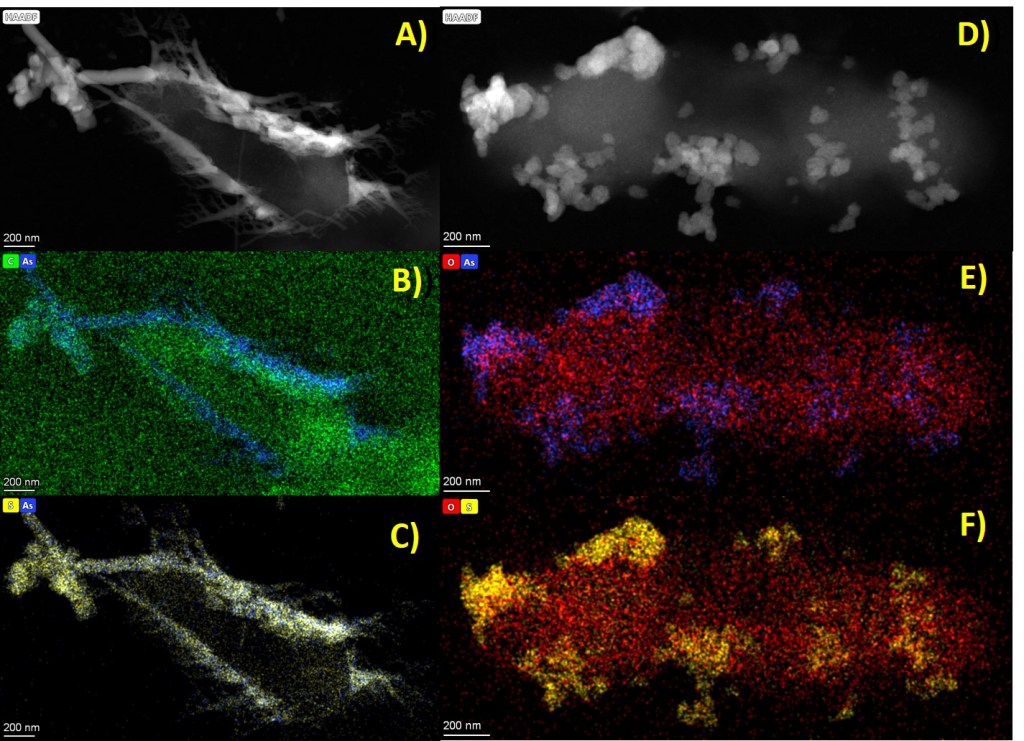
Arsenic sulfides (AsS) and elemental selenium (Se0) result from extracellular respiratory processes (Fig. 1AB-DEF) in a strain of Shwanella (Shewanella sp. O23S). Thus, the solid biominerals are disposed outside of the bacterial cell, protecting its internal structure. Biogenic sulfur (S0) is produced by the oxidation of H2S, the by-product of the sulfate respiration, being used as an electron donor. Iron minerals have a complex chemistry and are metastable (they transform from one mineral phase to another) (biomienrals produced by the sulfur-disproportionating bacterium Desulfocapsa sulfexigens) (Fig. 1C).
The biological functions of these biominerals are not always known, and more studies are needed to uncover the biomolecular pathways involved in controlling their formation.
Figure 1. Microbial biominerals. A) Extracellular Se0 produced by Shewanella sp. O23S (STEM mode); B) Elemental mapping (S – yellow-green; Se – red); C) Biogenic pyrite (blue) formed in the presence of goethite (orange) during incubation with the sulfur-disproportionating bacterium Desulfocapsa sulfexigens. Tübingen Structural Microscopy Core Facility (Muammar Mansor and Andreas Kappler). Both minerals were pseudocolorized; D) Extracellular AsS produced by Shewanella sp. O23S (STEM mode); E) Elemental mapping (As – blue); F) Elemental mapping (S – yellow). Panels A-B-D-E-F are from Staicu et al. (2025).
Applications of microbial biominerals
Because biominerals form from soluble metals, there is an increasing interest in their potential recovery from metal-rich industrial wastewaters (i.e. biomining). For instance, iron biominerals have been investigated in energy/electron storage (biogeobatteries). On the other hand, S0 biominerals are interesting candidates for use as cathode materials in high-capacity Li-S batteries. In contrast to the natural abundance of iron and sulfur, selenium is a trace element in the Earth’s crust and has numerous applications (e.g. energy production, micronutrient). The recovery of Se0 biominerals from selenium-laden industrial effluents using microbial metabolism is an important goal within the framework of circular economy, and various studies are being focused on this topic.
Microbial biomineralization is a key process in natural and anthropogenic environments. Certain bacteria and archaea produce cellular energy via anaerobic respiration using metals and metalloids as terminal electron acceptors, producing intra- and extracellular biominerals. This article explores the biomineralization of arsenic (As), iron (Fe), sulfur (S) and selenium (Se), in relation with microbial respiratory processes. Ferric iron (FeIII) and the oxyanions of As, S and Se are used as terminal electron acceptors by specialized bacteria and archaea, providing significant amounts of energy under anoxic and nutrient-limiting conditions. These transformations result in the formation of various types of arsenic sulfides, iron (oxyhydr)oxides and sulfides, elemental S/S0 and elemental Se/Se0 biominerals, which will be the focus of this review. Certain biominerals (e.g. S0) function as storage compounds; others, like Se0, may increase the density and the buoyancy of bacteria harboring them or are by-products of this process. Arsenic sulfides and iron (oxyhydr)oxides and sulfides appear to be by-product biominerals or have a yet unknown function. The use of these biominerals as biosignatures is an open topic and an ongoing debate. Further exploration of the reviewed biominerals is needed from both fundamental and applied viewpoints, aspects which will be covered in this review.
Biogenic AsS produced by Shewanella sp. O23S. Micrographs with the corresponding EDS elemental maps obtained from bacterial cells and biomineralization products: A) Scanning transmission electron microscopy (STEM mode) of nanorod (AsS) structures; B) Arsenic elemental mapping; C) Sulfur elemental mapping; D) Scanning transmission electron microscopy (STEM mode) of granular (As2S3) structures; E) Arsenic elemental mapping; F) Sulfur elemental mapping.
Summary of formation pathways for iron sulfides and the microorganisms involved. Fe(III)-reducers reduce various Fe(III) minerals to dissolved Fe2+. The reaction between dissolved Fe2+ and H2S released from sulfur-cycling microorganisms results in mackinawite precipitation. Its transformation to greigite and pyrite is accelerated in the presence of various intermediate sulfur species (S0, SSn2) produced by sulfur-cycling microorganisms and through the abiotic reaction between H2S and Fe(III) minerals.
The final conference of FULLRECO4US – Cost Action 20133 “Cross Border Transfer and Development of Sustainable Resource Recovery Strategies Towards Zero Waste” will be held in Basel (Switzerland) from May 5 to 7 May, 2025. Dr Staicu will contribute a poster on “Towards a biological function of biogenic Se0?”.
Details about the event can be found here and below:
Dr Staicu will present the paper “Microbial biomineralization: Sulfur variations” at BioHyMet-2025Workshop on Recent developments in biohydrometallurgy for the sustainable recovery of critical metals from primary and secondary waste streams (link). The event is organized by Eric van Hullebusch at Institut dePhysique du Globe de Paris (IPGP), Paris, France on April 2, 2025.
Dr Staicu will spend six months at Duquesne University (Pittsburgh, USA) as Scholar in Residence doing research with the team of Prof John Stolz. The research stage delves into microbial biomineralization and is funded by the Fulbright Program.
The project aims to elucidate the mechanisms by which bacteria generate cellular energy using “exotic” substrates, such as arsenic and selenium compounds, which display high toxicity to most living organisms. This strategy to produce energy in organic-poor environments played a key role in the early evolution of life on Earth. Unravelling this process from a molecular (enzymes and genes) perspective will help elucidate how life evolved and increased in complexity.
The webinar will explore the fundamentals of anaerobic respiration in bacteria, focusing on arsenic and selenium as respiratory substrates. As a case study, a bacterium investigated by our team and capable of extracellular respiration, Shewanella sp. O23S (belonging to Shewanella baltica), will be showcased.
The annual general conference of COST Action 19116 “Trace metal metabolism in plants – PLANTMETALS” will be held at the Department of Biology, Biotechnical Faculty, University of Ljubljana (Slovenia), September 17-20, 2024. The COST Action “PLANTMETALS tackles basic and applied issues related to trace metal deficiency or excess levels in plant physiology and crop production by the combined expertise of physiologists, (bio)physicists, (bio)(geo)chemists, molecular geneticists, ecologists, agronomists and soil scientists. The meeting will also include a botanical excursion: Visit of the Idrija valley and a Hg (mercury) mine.
Dr Staicu will have a communication on “Bacterial endophytes: ecological and biotechnological agents“, exploring the isolation of bacterial endophytes from selenium hyperaccumuator plants from Colorado, as well as their potential biotechnological applications.
Dr. Staicu will participate at the workshop “Matching diverse feedstocks for biochemical recovery: Impact fof their quality” with a talk on “Critical Raw Materials: The recovery of barite (BaSO4) from industrial effluents”. The workshop will be held in Valencia (Spain) in hybrid format, 10-11/07/2024, and is organized by Mª Belén García Fernández from Spanish Packaging Technology Platform (PACKNET) in the framework of the FULLRECO4US COST Action.












 Geomicrobiology