Dr Staicu will give a talk (January 28, 1:20 PM, GMT+1) on biominerals and bioremediation for the 17th Winter School in Mineral Sciences (Veszprem, Hungary) organized by Prof. Mihaly Posfai and his team. The talk will explore the formation of AsS and Se0 biominerals by a strain of Shewanella, as well as its bioremediation capacity on real industrial effluents rich in metals.
At the invitation of Prof. Mohamed Merroun(University of Granada), Dr Lucian Staicu will give an workshop on scientific writing and the publication process on 16/11/2021.
The workshop will cover the following topics and will be open to MSc and PhD students:
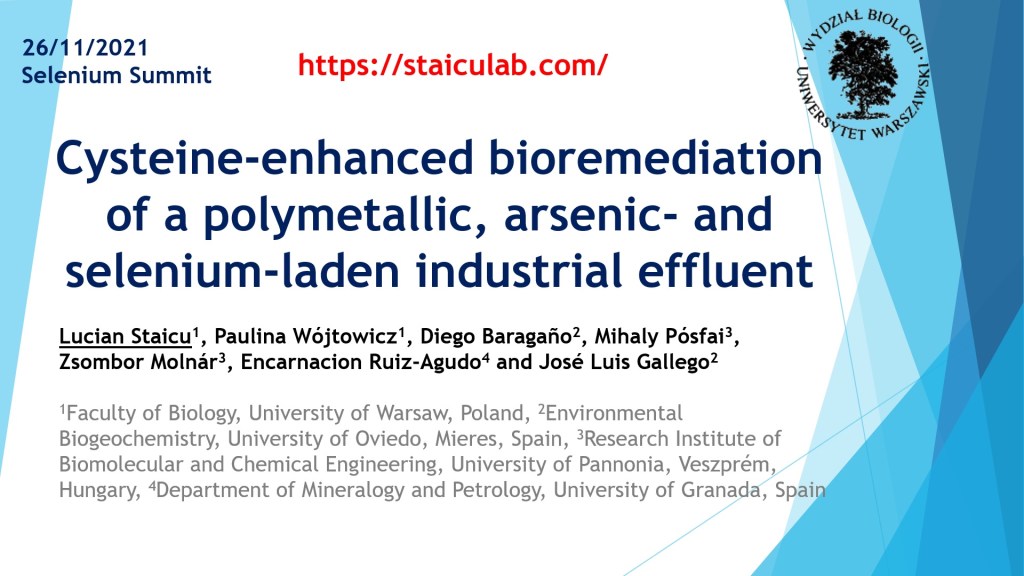
Dr Staicu will contribute the following communication “Cysteine-enhanced bioremediation of a polymetallic, arsenic- and selenium-laden industrial effluent” at the Selenium Summit2021 (26-28/11/2021, online), event organized by Electric Power Research Institute (EPRI).
The results that will be presented were recently published in Letters in Applied Microbiology (here).
A new article “Bioremediation of a polymetallic, arsenic-dominated reverse osmosis reject stream” was published in Letters in Applied Microbiology by our team (Dr. Lucian Staicu and Paulina Wojtowicz) in collaboration with Prof. Mihaly Posfai and Zsombor Molnar (University of Pannonia, Veszprem, Hungary), Prof. Encarnacion Ruiz-Agudo (University of Granada, Spain) and Dr. Diego Baragano and Prof. Jose Luis Gallego (University of Oviedo, Spain).
The article explores the bioremediation potential of a real industrial effluent (retentate stream from a full-scale reverse osmosis plant treating mine water) using a metal-resistant bacterial culture, Shewanella sp. O23S. The results show cysteine metabolism significantly increases the removal yield of several pollutants such as As (27%), Co (80%), Cu (96%), Mo (78%), Se (88%), Sb (83%), and Zn (90%). The contribution of cysteine as a source of H2S to enhancing the removal yield was confirmed by its addition after seven days of incubations initially lacking it. Additionally, the cysteine-sourced H2S was confirmed by its capture onto headspace-mounted Pb-acetate test strips that were analyzed by X-ray diffraction. We show that real metal-laden industrial effluents can be treated to medium-to-high efficiency using a biological system (naturally-sourced inocula) and inexpensive reagents (yeast extract, lactate and cysteine).
This study provides evidence of the medium-to-high removal of metals and metalloids present in real industrial effluents by using naturally-sourced metal-resistant bacterial inocula. Apart from the applied research significance, the coupling of cysteine degradation to metal removal sheds light into the microbially-driven natural attention of industrial pollution in specific geochemical settings. The results warrant the scaling up of the process to treat larger effluent volumes and potentially recover valuable metals in the form of metal sulfides.
The symposium “Biogeochemistry of minerals and strategic metals in remediation and energy transition” will explore topics related to bioremediation and phytoremediation, metal pollution, resource recovery of critical raw materials, and environmental microbiology and will be organized at University Friedrich-Schiller (Jena, Germany) on 4-5 October 2021.
Our contribution presents the cysteine-enhanced bioremediation of a polymetallic industrial effluent using a metal-resistant strain of Shewanella, being the product of a collaborative project of our team (Paulina Wojtowicz and Dr Lucian Staicu) with University of Oviedo (Dr Diego Baragano and Prof Jose Luis Gallego), University of Granada (Prof Encarnacion Ruiz-Agudo) and University of Pannonia (Zsombor Molnar and Prof. Mihaly Posfai). This study is currently in press at Letters in Applied Microbiology.
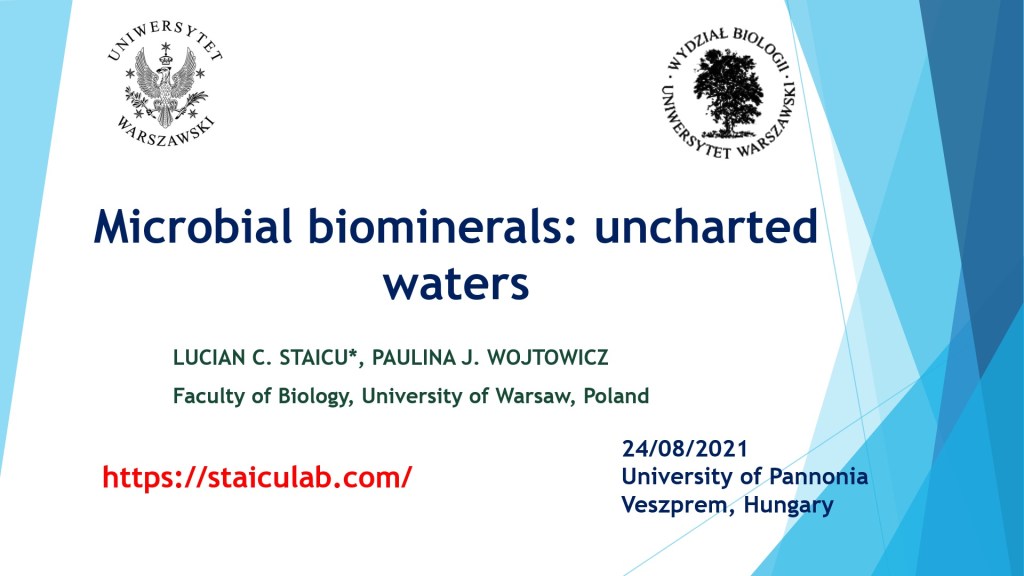
Dr Lucian Staicu will deliver a talk on microbial biominerals on August 22 at University of Pannonia, Veszprem, Hungary at the invitation of Prof. Mihaly Posfai.
The final version of our article “Selenium respiration in anaerobic bacteria: Does energy generation pay off?” (here) published by Journal of Inorganic Biochemistry is online. Dr Staicu and prof. Larry Barton critically discuss the implications of anaerobic respiration based on selenium in phylogenetically-diverse bacteria.
This review article provides an in-depth analysis of selenium respiration (model selenium respiring bacteria, thermodynamics, respiratory enzymes, and genetic determinants), complemented by an extensive discussion about the evolutionary implications and the properties of biogenic Se0.
Our team was active at the recent Goldschmidt2021 (Lyon, France – online format) conference contributing an oral presentation on the biogeochemistry of industrial effluents and a session on biominerals.
Talk:
Session 11d: “Reverse osmosis effluents: biogeochemical and mineralogical investigation”
Paulina Wojtowicz will do a research stage starting mid-May 2021 on biochemistry at Sapienza University of Rome with the team of Prof. Daniela de Biase (here).
Dr Staicu will spend April and May 2021 doing research on biomineralization with the team of Prof. Andreas Kappler at Eberhard Karls University of Tübingen (here).
















 Geomicrobiology